


1. What is a CNC Machining Center?
A CNC (Computer Numerical Control) machining center is a highly automated, computer-controlled manufacturing platform that removes material from a workpiece to create custom parts. Driven by algorithmic instructions (G-code and M-code), these machines automate the operations traditionally performed by manual machinists, controlling the precise movement of cutting tools like end mills, drills, and reamers relative to the workpiece.
Unlike basic CNC machines that might only perform a single operation (like a plasma cutter or a simple drill press), a true CNC machining center is equipped with an Automatic Tool Changer (ATC) and a tool magazine. This allows the machine to automatically swap cutting tools in seconds, enabling milling, drilling, boring, and tapping to be completed in a single, uninterrupted setup. Whether producing microscopic medical implants or multi-ton aerospace structural components, CNC machining centers provide the scalability, repeatability, and extreme precision required to drive modern industry.
According to the National Institute of Standards and Technology (NIST), modern CNC machining centers have revolutionized manufacturing by achieving tolerances within ±0.002 mm while maintaining production speeds that manual machining simply cannot match.
2. Types of CNC Machines
CNC technology encompasses a vast ecosystem of machines. While they all share the same foundational computer control principles, their mechanical configurations dictate their specific industrial roles. The CNC machining center category includes several distinct types, each optimized for different applications.
Vertical Machining Center (VMC)
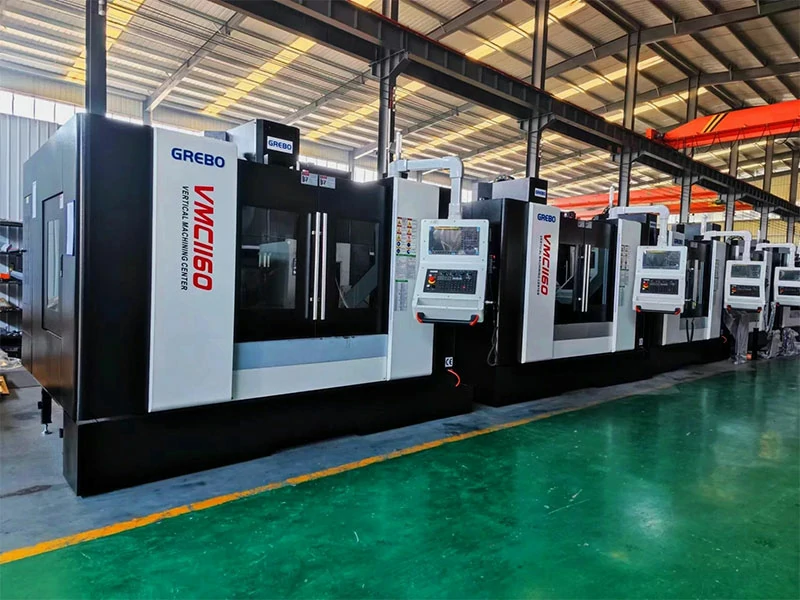
The Vertical Machining Center (VMC) is the workhorse of the manufacturing world. It features a vertically oriented spindle that approaches the workpiece from above. VMCs are incredibly versatile, excelling at face milling, drilling, and tapping prismatic parts.
- Core Components: High-performance spindles (ranging from 8,000 to 15,000+ RPM), rigid Meehanite cast iron frames to absorb chatter, and ATCs (Twin-arm for rapid industrial swapping, or Umbrella types for cost-effective lighter duty).
- Guideway Systems: VMCs are defined by their way systems. Box Ways offer massive sliding contact surfaces, providing superior vibration damping and load capacity for heavy, aggressive steel cutting. Linear Guideways use recirculating roller bearings for low-friction, high-acceleration motion, making them ideal for high-speed aluminum machining and fine mold finishing.
Choosing the right CNC machining center with vertical orientation depends on your part complexity and production volume requirements.
Horizontal Machining Center (HMC)
In an Horizontal Machining Center (HMC), the spindle is oriented horizontally. This seemingly simple change revolutionizes chip management and production volume.
- Gravity Chip Evacuation: Chips fall naturally away from the cut zone, preventing recutting, heat buildup, and tool wear, which ensures better surface finishes and thermal stability.
- Pallet Systems & Tombstones: HMCs utilize Automatic Pallet Changers (APC). Operators can load/unload parts on a stationary pallet while the machine cuts on another. Parts are often mounted on vertical “tombstone” fixtures attached to a 4th-axis rotary table, allowing 4-sided machining in a single setup.
For high-volume production, an HMC-type CNC machining center delivers unmatched efficiency and throughput.
Gantry Machining Center (Bridge Mill)
When parts exceed the physical envelope of a C-frame VMC, the Gantry Machining Center or Bridge Mill takes over. Instead of a single vertical column, the spindle is mounted on a crossbeam supported by two massive vertical columns.
- Monobloc Construction: This one-piece cast iron design distributes cutting forces symmetrically. It provides the immense structural mass and damping capacity necessary to support heavy die blocks and minimize deflection during aggressive material removal on massive workpieces.
CNC Lathe & Turning Centers
While a basic 2-axis CNC lathe rotates a workpiece against a stationary tool to create cylindrical shapes (shafts, bushings), modern CNC Turning Centers are multi-axis marvels that complement traditional machining centers.
- Live Tooling & Multi-Axis: Advanced slant-bed turning centers integrate live (powered) tooling in the turret, along with Y-axis and C-axis control. This allows the machine to mill slots, drill cross-holes, and tap threads while the part is still chucked, eliminating secondary operations.
- Thermal Management: High-speed turning generates immense heat. Premium lathes use symmetric machine designs, spindle chillers, and real-time thermal compensation algorithms to adjust tool paths dynamically, counteracting structural expansion and maintaining tight tolerances.
Other Specialized CNC Technologies
Beyond traditional subtractive milling and turning, the CNC ecosystem includes specialized processes that work alongside CNC machining centers:
- CNC EDM (Electrical Discharge Machining): Uses controlled electrical arcs to erode conductive materials. Essential for machining hardened steels, carbides, and intricate mold cavities without inducing mechanical stress. (Wire EDM for profiles, Sinker EDM for deep pockets).
- CNC Laser Cutters: Uses focused light beams (CO2 for non-metals, Fiber for metals) to achieve ultra-precise cuts with kerf widths as small as 0.1 mm and minimal heat-affected zones (HAZ).
- CNC Waterjet Cutters: Uses ultra-high-pressure water mixed with abrasives to cut virtually any material (stone, glass, thick metals) without generating heat, though it is slower around tight corners.
- CNC Plasma Cutters: Uses an ionized gas arc to cut conductive metals. Extremely fast for thick plates but leaves a visible HAZ and offers lower edge precision than lasers.
- CNC Routers: High-speed (up to 24,000 RPM), large-format machines optimized for softer materials like wood, plastics, foam, and composite panels.
- CNC Grinders: Uses abrasive wheels to achieve nanometer-level surface finishes (down to Ra 0.2 micrometers) and micrometer tolerances on hardened parts post-heat-treat.
3. Difference Between HMC, VMC, and Gantry
Selecting the right CNC machining center architecture is the most critical decision in facility planning. The choice dictates your chip management strategy, part size limits, fixturing complexity, and ultimate throughput.
| Feature | Vertical Machining Center (VMC) | Horizontal Machining Center (HMC) | Gantry / Bridge Mill |
|---|---|---|---|
| Spindle Orientation | Vertical (Z-axis top-down approach) | Horizontal (Side-in approach) | Vertical (Overhead crossbeam) |
| Chip Evacuation | Poor. Chips pool in pockets; requires high-pressure coolant flushes. | Excellent. Gravity pulls chips directly away from the cut and onto conveyors. | Good, but requires robust, wide conveyors for massive chip volumes. |
| Work Envelope & Weight | Small to Medium. Limited by Z-axis height and table deflection. | Medium. Cubical work area optimized for tombstone fixturing. | Massive. Handles multi-ton, oversized parts with wide X/Y travel. |
| Fixturing & Setup | Simple flat table. Easy to fixture, but requires multiple setups for multi-sided parts. | Complex but highly efficient. 4-sided machining in one setup via pallets. | Heavy-duty custom fixtures. Parts are often bolted directly to the massive bed. |
| Rigidity & Damping | Good. C-frame can experience slight deflection under extreme heavy loads. | Excellent. Compact structural loop provides immense rigidity. | Ultimate. Monobloc bridge design eliminates column deflection entirely. |
| Production Volume | Low to High. Great for job shops, plates, and mold bases. | Very High. Designed for lights-out manufacturing and FMS integration. | Low to Medium. Long setup times; used for massive, low-mix parts. |
| Primary Industries | General machining, electronics, medical, mold base prep. | Automotive (engine blocks), aerospace structural, hydraulics. | Aerospace (wing spars), energy (wind hubs), large stamping dies. |
4. How to Choose the Right CNC Machine
Purchasing a CNC machining center is a major capital expenditure that can range from $15,000 for a basic lathe to over $500,000 for a 12-axis mill-turn center. A structured, data-driven buying framework prevents costly mismatches between machine capability and production demands.
Step 1: Define Part Envelope & Kinematics (Axis Count)
Your part geometry dictates the axis count and control system required for your CNC machining center:
- 2-Axis to 3-Axis: Ideal for flat parts, holes, and simple profiles. Uses Point-to-Point or basic Contouring control. (Cost: $10k – $100k).
- 4-Axis: Adds a rotary axis (A or B) for camshafts or cylindrical camming.
- 5-Axis (Trunnion-Table or Swivel-Head): Mandatory for aerospace impellers, medical implants, and complex molds. Allows the tool to approach from any angle, eliminating cumulative errors from multiple setups. (Cost: $150k – $500k+).
- 9-Axis & 12-Axis Mill-Turn: Combines a lathe and a mill. A 9-axis machine can machine internal and external features simultaneously. 12-axis machines feature dual cutting heads, exponentially increasing accuracy and doubling production speed for complex medical/aerospace parts.
Step 2: Spindle Performance & Tooling Compatibility
The spindle is the heart of any CNC machining center. Match its characteristics to your materials:
- Speed vs. Torque: Aluminum and composites require high RPM (15,000+) and low torque. Hardened steels and titanium demand low RPM but massive low-end torque. A two-step geared head spindle is the ultimate solution if you need to cut both on the same machine.
- Taper Standards: CAT40 / BT40 is the standard for high-speed, general-purpose machining. CAT50 features a larger frame providing the extreme rigidity needed for heavy-duty steel roughing. Note: BT40 (metric flange) and CAT40 (imperial) are non-interchangeable.
- Big-Plus / Dual-Contact: For high-speed machining, centrifugal force causes standard toolholders to pull out of the spindle. Dual-contact systems engage both the taper and the spindle face simultaneously, increasing axial rigidity.
Step 3: Coolant & Chip Management Systems
Effective coolant delivery is critical for CNC machining center performance:
- Flood Coolant: High-volume, low-pressure. The industry standard for general machining and washing chips.
- Through-Spindle Coolant (TSC): High-pressure fluid (up to 1000+ PSI) blasted directly through the tool. Indispensable for deep-hole drilling and sticky materials (like aluminum or titanium) to force chips out and prevent re-cutting.
- Mist Coolant: Atomized spray for light finishing or where thermal distortion from flood coolant is a concern.
Step 4: Facility Preparation & Acceptance Testing
Do not ignore the environment. High-precision CNC machining centers require a dedicated, reinforced concrete pad isolated from building vibrations. You must verify utility infrastructure: stable electrical supply (within ±5% voltage), clean compressed air (100+ PSI), and thermal stability.
5. Applications
Different industries push CNC machining centers to their absolute mechanical limits, demanding specific configurations to meet regulatory and physical requirements.
Automotive & High-Volume Manufacturing
The automotive sector is defined by cycle time, consistency, and volume. Engine blocks, cylinder heads, and transmission housings require tolerances as tight as ±0.005 mm.
- Machine of Choice: Horizontal Machining Centers (HMCs) integrated into Flexible Manufacturing Systems (FMS).
- Why: The horizontal spindle allows chips to fall away naturally, enabling continuous, multi-sided machining. Robotic cells and pallet changers allow for “lights-out” unattended operation, producing millions of identical parts with zero dimensional drift.
Aerospace & Defense
Aerospace manufacturing operates under extreme regulatory frameworks like AS9100 and NADCAP. Parts like landing gear, engine disks, and turbine blades are machined from exotic, heat-resistant superalloys like Titanium and Inconel.
- Machine of Choice: 5-Axis CNC machining centers and heavy-duty VMCs.
- Why: Exotic materials work-harden rapidly and generate intense heat, requiring high-torque spindles, extreme structural rigidity, and high-pressure TSC to maintain tolerances within ±0.002 mm. 5-axis kinematics are critical to machine complex freeform contours and undercuts in a single setup, eliminating cumulative fixturing errors.
Mold, Die, & Tool Manufacturing
Mold making bridges the gap between heavy roughing and ultra-fine finishing. Injection mold cavities require nanometer-level surface finishes to prevent plastic part sticking and eliminate hundreds of hours of manual polishing.
- Machine of Choice: High-Speed VMCs (20,000+ RPM spindles), Bridge Mills (for massive stamping dies), and EDM Centers.
- Why: Shops use a hybrid approach. CNC mills perform “hard milling” on hardened steels using coated carbide tools and fine-pitch toolpaths. For sharp internal corners, thin webs, or deep ribs that would break a milling cutter, Wire and Sinker EDM takes over to erode the material stress-free.
Heavy Industry & Energy
Sectors like wind energy, mining, and shipbuilding deal with massive scale. Parts like wind turbine hubs, large marine engine components, and multi-ton automotive stamping dies weigh thousands of pounds.
- Machine of Choice: Gantry Machining Centers (Bridge Mills) and large-frame Box-Way VMCs.
- Why: The immense structural mass and damping capacity of a Monobloc bridge construction are the only ways to support heavy die blocks and prevent deflection during aggressive, deep-cavity material removal.
For more information on manufacturing standards, visit SME (Society of Manufacturing Engineers) and Engineering.com.
6. Our CNC Machine Solutions
At our core, we understand that the right CNC machining center configuration, precision maintenance, and industry-specific setup drive long-term manufacturing success. The transition from manual machining to advanced CNC automation, or the leap from 3-axis to 5-axis and mill-turn capabilities, requires a partner who understands the physics of metal cutting.
We offer a robust, engineering-driven lineup of high-performance VMCs, HMCs, 5-Axis platforms, and heavy-duty Bridge Mills tailored to your specific production goals. Whether you are machining PEEK for medical implants, Inconel for aerospace, or cast iron for automotive blocks, our CNC machining center solutions are designed to match your workflow.
By partnering with us, your business benefits from maximized spindle uptime, drastically reduced scrap rates, and the sub-micron accuracy needed to scale production with absolute confidence. Let’s move your production forward.
Frequently Asked Questions (FAQs)
Start with a user-friendly 3-axis CNC machining center equipped with conversational programming or integrated smart CNC features. This streamlines production and reduces manual intervention, enabling a high-precision transition without requiring complex, master-level G-code programming knowledge. Entry-level mills start around $10,000, making the barrier to entry highly manageable.
Yes, but it requires specific hardware. You must select a CNC machining center with a two-step geared head spindle. This provides high torque at low RPM for heavy steel roughing, while still allowing the high RPMs necessary for efficient, high-speed aluminum machining. Alternatively, a high-torque belt-driven spindle can offer a compromise, but a geared head is the ultimate solution for heavy steel.
Industrial environments are prone to voltage spikes from heavy equipment cycling on and off. Installing a dedicated voltage regulator or an isolation transformer is the best defense. This ensures your CNC machining center controller and servo drives remain within the required ±5% voltage stability range, preventing catastrophic motherboard failures.
Mechanically, no. The linear axes and spindles require the same preventive maintenance (lubrication, way covers, coolant management). However, you must perform more frequent kinematic calibrations. Using a wireless probe to verify that the rotary centerlines (A/C or B axes) remain perfectly aligned with the linear axes is critical to maintaining 5-axis CNC machining center accuracy over time.
If the processor is too slow, it cannot pre-read complex G-code blocks fast enough (low “look-ahead” capability). The CNC machining center will stutter or “dwell” during complex 3D mold finishing, resulting in visible witness lines, poor surface quality, and significantly longer cycle times. High-speed finishing demands a powerful processor to maintain smooth, continuous path motion.
Operating costs vary wildly based on machine type and overhead:
• CNC Routers / Grinders / Plasma: ~$15 – $25 per hour.
• CNC Lathes / 3-Axis Mills: ~$40 per hour.
• EDM / Waterjet / Laser: ~$20 – $30 per hour (excluding high abrasive/wire costs).
• 5-Axis / Multi-Axis Machining Centers: $100 – $200+ per hour, reflecting the massive capital depreciation and complex programming required.
There are three main types of positioning controls:
1. Point-to-Point (PTP): The tool moves to a specific location and then machines (used for drilling/punching).
2. Straight Cut: The tool machines while moving, but only parallel to one axis at a time (no curves).
3. Contouring Path (Continuous Path): The most advanced and expensive. It controls multiple axes simultaneously to create complex 3D curves and surfaces. Almost all modern CNC machining centers and turning centers use Contouring Path control.