


In modern precision manufacturing, choosing the right vertical vs horizontal machining center not only determines the upper limit of a workshop’s production capacity but also directly impacts part machining quality, production costs, and the enterprise’s return on investment.
When planning a machining center selection guide, many enterprises evaluating vertical vs horizontal machining center options are often misled by the “paper specifications” of the equipment, ignoring their limitations in actual workshop environments.
In this guide, we will break down the core differences, technical advantages, and limitations of machining centers. Combined with material adaptability, precision control, and CNC machining ROI analysis, we provide a highly practical and in-depth technical comparison.
Core Differences Between Vertical and Horizontal Machining Centers
Spindle Layout and Kinematic Logic
The fundamental divergence in the vertical vs horizontal machining center comparison stems from the physical differences in spindle spatial layout and worktable movement logic, which directly determine their respective strengths.
Structural Characteristics of VMC
- Spindle & Layout: The spindle is vertical to the worktable, cutting top-down. The structure is mostly a fixed column, with a T-slot cross-slide worktable responsible for X and Y linear movements. If you are looking for standard models, our Vertical Machining Center lineup covers these exact configurations.
- Spindle Configuration Diversity: VMCs offer rich spindle configurations to adapt to various conditions, including belt-driven spindles (general high-efficiency, high-rigidity hard-way models), direct-drive spindles (high-speed high-efficiency models), and motorized spindles (high-efficiency high-precision models, often used for mold finishing).
- Worktable Features: Typically a rectangular worktable without indexing rotation. If spiral parts need machining, a 4th-axis rotary table can be added.
Structural Characteristics of HMC
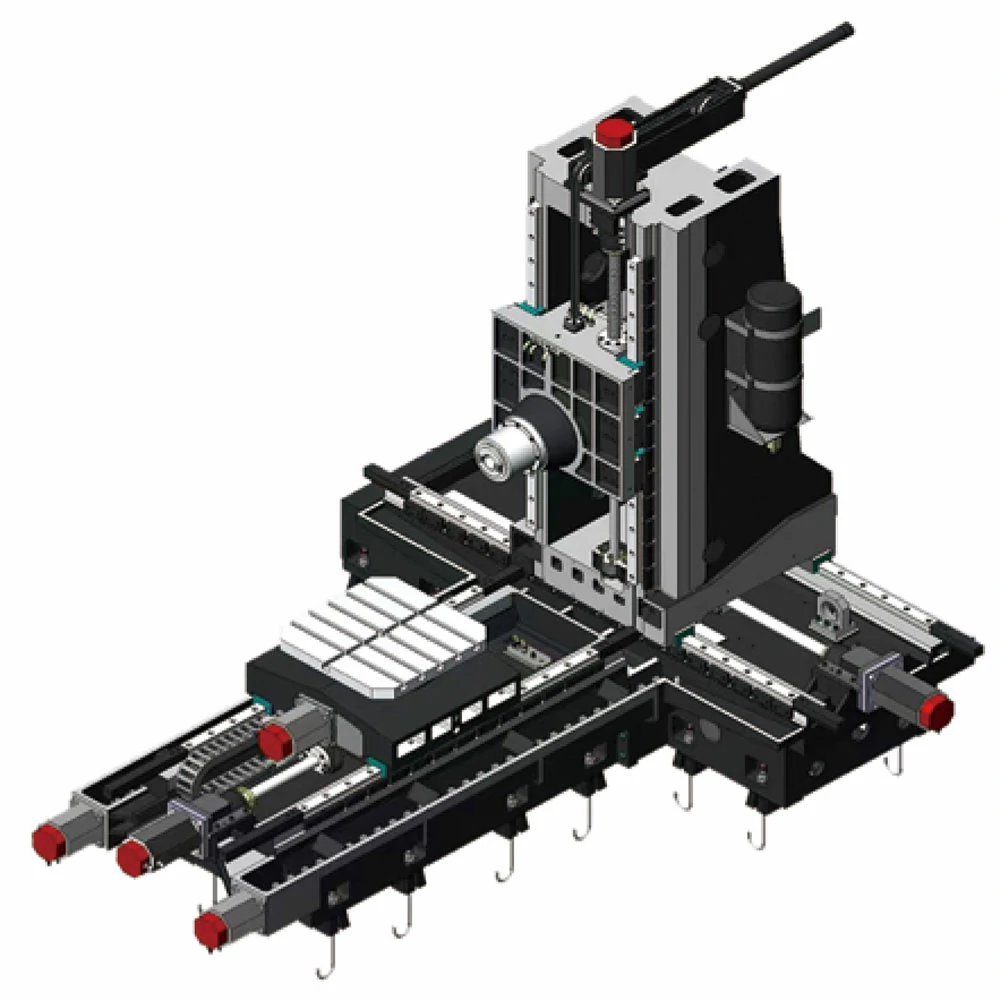
- Spindle & Layout: The spindle is arranged horizontally, parallel to the ground. The tool cuts horizontally from the side. Our Horizontal Machining Center series is engineered specifically for this heavy-duty kinematic logic.
- Worktable & Indexing: Usually equipped with an automatic indexing rotary worktable (B-axis), commonly configured as 3 linear + 1 rotary coordinate (3+1 or 4-axis). The worktable is often a rotary type with a dot-matrix threaded surface, easily adaptable to exchangeable double worktables (pallet pools).
- Bed Rigidity: To withstand the massive overturning moments from horizontal cutting, HMCs use high-rigidity beds, columns, and spindle structures, making their overall weight and volume far exceed equivalent VMCs.
The Essential Difference in Chip Evacuation
VMC’s Chip Evacuation Challenge: Affected by gravity, when machining deep cavities or blind holes, chips easily accumulate on the workpiece surface or cavity bottom. This requires frequent machine stoppages for cleaning or reliance on high-pressure Center Through Spindle (CTS) coolant to flush chips. It easily leads to “re-cutting” of chips, severely accelerating tool wear and ruining surface finish.
HMC’s Chip Evacuation Advantage: This vertical vs horizontal machining center difference in chip evacuation is crucial for difficult materials. The horizontal spindle allows chips to naturally fall into the chip conveyor under gravity, completely solving the chip accumulation problem in deep cavities. This not only protects the machined surface but also allows for more aggressive cutting parameters, significantly extending tool life.
Comparison of Multi-Sided Machining Capabilities
VMC’s Limitations: When analyzing the vertical vs horizontal machining center debate for multi-sided capabilities, VMCs fall short. Manual or 4th-axis flipping and re-clamping are required. This results in a spindle utilization rate of only about 25%, and more fatally, multiple setups accumulate positioning errors, making it difficult to guarantee strict cross-face geometric tolerances.
HMC’s Core Advantage: Paired with a rotary worktable and tombstone fixtures, an HMC can machine 4 or even 5 sides of a part in a single setup. This completely eliminates cumulative errors from flipping, easily controlling cross-face positional tolerances within 0.005mm.
VMC vs HMC: Pros, Cons, and Applications
Vertical Machining Center (VMC): Advantages, Limitations & Applications
Core Advantages Summary
- Ultimate Visibility & Operability: The vertical spindle allows operators to observe the cutting process without obstruction, facilitating real-time monitoring of cutting sounds and chip status. Setup is convenient, and program debugging is highly intuitive, requiring a relatively lower technical threshold for operators.
- Excellent Single-Sided & 2.5D Machining: For plates, disks, molds, and small housings, VMCs efficiently perform milling, boring, drilling, and tapping. The vertical cutting force aligns with gravity, ensuring extremely stable clamping.
- Space & Cost Friendliness: Relatively simple structure, small footprint, no complex foundation reinforcement needed. Initial procurement costs are affordable, making it the first choice for SMEs.
- Rich Spindle Ecosystem: From high-speed motorized spindles for ultimate surface finish to high-rigidity belt-driven hard-way spindles for cast iron roughing, VMCs offer the widest configuration options, perfectly matching mold, electronics, and medical industries.
Technical Limitations & Pain Points
- Chip Evacuation Nightmare & “Re-cutting”: Severe chip accumulation in deep cavities requires frequent cleaning or high-pressure coolant, leading to tool wear and surface quality degradation.
- Multi-Sided Machining Bottleneck: Multiple setups lead to low spindle utilization (~25%) and accumulated positioning errors that fail to guarantee strict tolerances.
- “Chatter” Limitation of Long Tools: Long tool overhang in deep cavities causes chatter, limiting Material Removal Rate (MRR) and struggling with heavy roughing of difficult-to-machine materials.
Typical Applications
- Mold & Cavity Manufacturing: Complex 3D surface finishing using high-speed motorized spindles.
- Medical & Electronics: Bone implant prototypes, precision instrument housings, heat sinks.
- Aerospace Prototyping: Rapid prototype verification of aircraft ribs and frames using 5-axis VMCs.
- Job Shops: Handling high-mix, low-volume, frequent changeover diversified orders.
Horizontal Machining Center (HMC): Advantages, Limitations & Applications
Core Advantages Summary
- Natural Gravity Chip Evacuation: Chips fall naturally, completely solving deep cavity accumulation, allowing aggressive cutting parameters and extending tool life.
- Single Setup, Multi-Sided Machining (OP10/OP20 Combined): Machines 4-5 sides in one setup, eliminating cumulative errors. Cross-face positional tolerance easily controlled within 0.005mm.
- High Spindle Utilization & Automation Potential: Standard double worktable/pallet pool systems allow external loading/unloading while internal machining occurs. Spindle utilization can soar to over 85%, making it the perfect carrier for “lights-out” unattended manufacturing.
- Heavy Cutting Stability: Horizontal cutting forces are absorbed by the robust column and bed. With short, thick tool holders, HMCs show unparalleled rigidity and anti-vibration properties when machining hard materials or deep-hole drilling.
Technical Limitations & Pain Points
- High “Iceberg” Costs: HMC procurement is 2-3 times that of VMCs. Additionally, expensive tombstone fixtures, precision pallets, tool setters, and probes are required, representing massive hidden investments.
- Strict Footprint & Infrastructure: Massive machines, pallet exchangers, and full enclosures require huge workshop space. High-speed vibration often requires special foundation reinforcement.
- High Technical Threshold & Programming Complexity: Multi-axis linkage and spatial coordinate transformation (RTCP) demand high CAM programming and debugging skills. First-article setup and verification take much longer than VMCs.
- Physical Limits for Oversized/Overweight Parts: Parts hang vertically on pallets. Severe center-of-gravity offsets or extreme weights create massive overturning moments. For giant, irregular castings, large gantry VMCs or floor-type boring mills are safer.
Typical Applications
- Automotive & Powertrain: High-volume machining of engine blocks, transmission housings, clutch housings.
- Hydraulics & Fluid Control: Hydraulic valve blocks, manifolds, pump bodies with complex internal cross-holes and strict cross-face tolerances.
- Heavy Machinery & Energy: Large reducer boxes, wind turbine hubs, turbine components.
- High-Volume Production: Stable orders over 500 parts/month, pursuing ultimate cost-per-part compression.
Material Adaptability & Precision Control
Understanding how each machine handles materials is key to the vertical vs horizontal machining center decision. Let’s look at the data:
| Material Type | VMC Performance & Countermeasures | HMC Performance & Countermeasures | Best Configuration Recommendation |
|---|---|---|---|
| Aluminum Alloys | Prone to long stringy chips; relies on high-pressure coolant and high-helix tools; deep cavities easily clog. | Gravity evacuation perfectly solves stringy chips, enabling extremely high MRR. | HMC Preferred (High Volume) / VMC (Low Volume) |
| Stainless Steel / Titanium | Severe work hardening; long tools prone to chatter; strict depth-of-cut control needed. | High-rigidity bed + short tool design effectively suppresses chatter, ensuring surface integrity. | HMC Preferred |
| Cast Iron | Crumbly chips don’t stick easily; VMC table supports well, ideal for large bases. | Requires robust chain-type conveyors and spindle labyrinth seals to prevent dust intrusion. | Depends on Part Geometry |
| Hardened / Mold Steel | High-speed motorized spindle + fine-grain coated tools for surface finishing. | Ideal for heavy roughing and deep cavity opening of mold bases and frames. | VMC for Finishing / HMC for Roughing |
Precision Myth: In-Plane vs. Cross-Plane Accuracy
- In-Plane Accuracy: When machining hole patterns or contours on the same plane, as long as machine geometry is up to standard, VMC and HMC perform identically (both depend on ballscrew and linear scale closed-loop accuracy).
- Cross-Plane Accuracy: This is HMC’s absolute domain. VMCs require multiple setups for multi-face parts, accumulating errors of 0.02mm-0.05mm. HMCs, via a single 4th-axis setup, achieve cross-plane positional tolerances far superior to VMCs. For hydraulic valve blocks, HMC is the only choice to guarantee sealing.
Machining Center Selection and CNC Investment Return (ROI) Analysis
Financial Perspective: TCO & ROI Model
When planning a machining center selection guide, the economic account must be calculated. The financial outcome of the vertical vs horizontal machining center choice heavily relies on the Total Cost of Ownership (TCO) and Break-Even Point models.
Cost Structure Comparison (TCO)
- VMC: Low initial procurement ($150k-$400k), simple fixtures, low maintenance costs. However, labor allocation per part is high, and scrap risk costs are higher during multi-sided machining.
- HMC: High initial procurement ($500k-$1.5M+), massive investment in pallet/tombstone fixtures, high energy and maintenance costs. But labor cost per part is extremely low, MRR is high, and tool life is longer.
Break-Even Point
Industry empirical data shows that 300 parts per month is a critical watershed in the vertical vs horizontal machining center ROI calculation:
- < 200 parts/month: VMC ROI wins completely. Fast changeovers and low fixture costs bring the fastest cash flow recovery.
- > 500 parts/month: HMC economies of scale emerge. Automated pallet pools and single-setup advantages can compress cost-per-part to 50% or less of VMCs.
- 200 – 500 parts/month: Requires precise calculation based on part complexity (number of cross-face tolerances, deep cavity ratio).
ROI Scenario Calculation
- Job Shop Model: Buy mid-range VMC, invest $250k, focus on flexible orders and fast delivery. Expected payback: 18-24 months.
- Mass Production Line Model: Buy HMC (with pallet system), invest $1.2M, focus on 24/7 lights-out machining. Despite huge initial investment, extremely low labor intervention and high spindle utilization usually achieve ROI within 8-12 months.
Decision Matrix Based on Business Strategy
| Decision Dimension | Signal to Firmly Choose VMC | Signal to Must Invest in HMC |
|---|---|---|
| Part Characteristics | Plates, disks, molds, single-sided/2.5D features dominant. | Complex boxes, valve bodies, multi-face hole systems, strict cross-face tolerances. |
| Production Volume | High-mix, low-volume (<200 parts/mo), frequent changeovers. | Stable batch, part families (>500 parts/mo), long-term orders. |
| Workshop Space | Limited space, cannot reinforce foundations or expand. | Ample space, dedicated automation cell planning. |
| Talent Pool | Relies on skilled technicians, programming/debugging skills are growing. | Strong CAM programming team and process engineering team. |
| Strategic Goal | Fast market response, pursuing cash flow and flexibility. | Reduce cost-per-part, step towards Industry 4.0 and unmanned manufacturing. |
Towards a Hybrid Layout Future Workshop
Let’s be honest: in the game of vertical vs horizontal machining centers, it is never a black-and-white single-choice question. For medium-to-large manufacturing enterprises, the most scientific and resilient workshop layout is a “VMC + HMC” hybrid matrix.
Use VMCs to handle high-mix, low-volume, single-sided “long-tail orders” and mold development, maintaining enterprise agility and cash flow; use HMCs to lock in high-profit, high-volume “core box parts”, building a moat of cost and quality.
Deeply understanding the advantages, limitations, and financial logic of both, and formulating the most scientific machining center selection guide, is the only way to maximize CNC machining ROI and enterprise capacity in the fierce global manufacturing competition.
Frequently Asked Questions (FAQ)
Vertical Machining Centers (VMCs) are more suitable for small-batch production. When evaluating the vertical vs horizontal machining center options for low volumes, VMCs have the advantages of short setup times, low fixture costs, and intuitive operation. For production environments with monthly output below 200 parts and high product mix, VMC’s flexibility and low initial investment make it the best choice.
Not necessarily; it depends on the specific application scenario. The vertical vs horizontal machining center debate ends when you look at your specific parts. HMCs have obvious advantages in multi-sided machining and high-volume production, but their high procurement costs cannot be ignored. For simple parts or limited budgets, VMCs are actually more cost-effective.
The Total Cost of Ownership (TCO) for an HMC is typically 2 to 3 times that of a VMC. Specifically:
• Initial Procurement Cost: Mid-range VMCs are about $150k-$400k, while HMCs are about $500k-$1.5M+.
• Fixture Costs: VMC fixtures are relatively simple and cheap; HMCs require expensive tombstone fixtures and pallet systems.
• Operating Costs: HMCs consume more energy, but labor costs per part are significantly lower.
It is important to note that although HMC initial investment is high, in high-volume production, its cost-per-part may be much lower than that of a VMC.
It depends on production volume and part complexity:
• Small Batch (<200 parts/mo): VMC ROI is higher, typically paying back in 18-24 months.
• High Volume (>500 parts/mo): HMC ROI is significantly higher, typically paying back in 8-12 months.
Overall, the vertical vs horizontal machining center ROI calculation clearly favors HMCs in high-volume, complex part production, while VMCs offer better investment return value in terms of flexibility.